
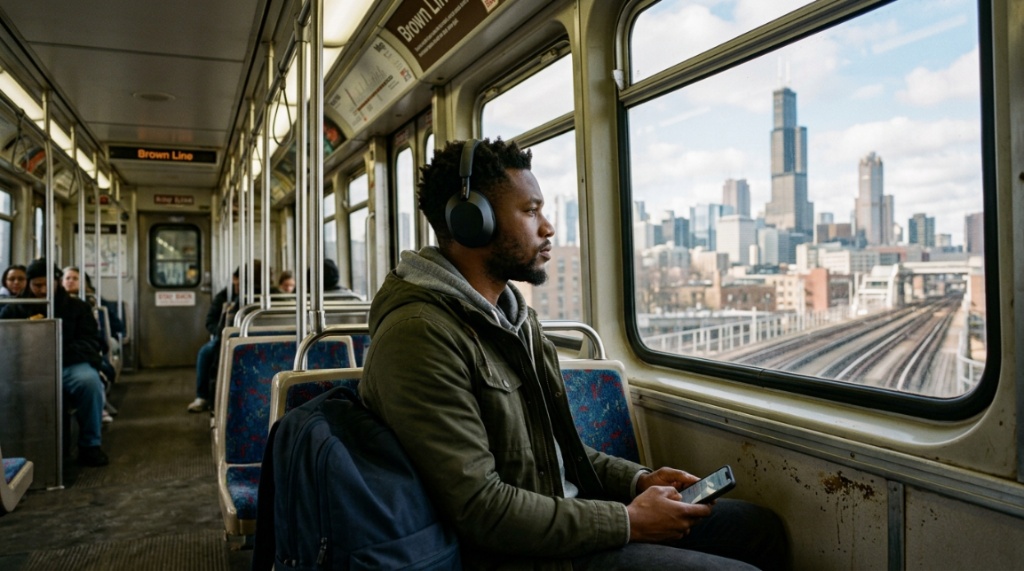
There’s a specific sound that defines Chicago commuting: the rumble of the CTA’s elevated lines, the screech of train brakes at Fullerton, the gusty wind tunneling through the Loop, and the low hum of buses idling on Michigan Avenue. If you ride the L daily, you know that standard earbuds aren’t enough—you need active noise cancellation that can handle the unpredictable, low-frequency rumble unique to this city. But with so many models on the market, how do you decide without relying on marketing hype? This guide breaks down exactly how to compare noise-cancelling headphones for the realities of Chicago travel, focusing on the features that actually matter when you’re waiting on a windy platform or squeezed into a crowded car during rush hour.
Key Takeaways
- Prioritize low-frequency cancellation: Chicago’s L tracks and bus engines create deep rumbles that require strong ANC, not just average noise blocking.
- Consider wind resistance: The windy city lives up to its name. You need headphones that handle wind noise without creating that distracting “puffing” sound in the microphones.
- Battery life isn’t just about the number: Look at real-world usage with ANC on, and check for quick-charge features for those long days out.
- Comfort and clamp force matter: A 45-minute ride is different from a full day of wear. Buy for comfort, not just specs.
- Check transparency modes: You need to hear the conductor’s announcements and be aware of your surroundings at street level.
Why “Chicago Daily Travel ANC Headphones” Are Different
Before jumping into specs, you have to understand the noise profile of the city. A noise-cancelling headphone that works perfectly on a quiet flight may fail completely on a rumbling Blue Line train. In Chicago, the majority of intrusive noise is low-frequency: the heavy diesel engines of Metra trains, the electric motors of the CTA L, and the deep vibrations transmitted through the tracks. Good ANC is built to counter these specific frequencies, but not all models do it equally. When you begin your research into Chicago daily travel ANC headphones, you aren’t just looking for “silence”; you are looking for targeted suppression of that specific mechanical rumble.
Furthermore, the commute isn’t just on the train. It involves the walk from your office to the station, waiting on elevated platforms where wind is a constant factor, and crossing busy intersections where you need to hear traffic. This means you aren’t just evaluating ANC strength in a vacuum; you are evaluating how the headphones handle wind, how well they allow ambient sound in when needed, and how comfortable they are for the entire door-to-door journey.
The Core Features to Scrutinize for City Commuting

When comparing models, it’s easy to get caught up in premium price tags and brand names. However, for Chicago daily travel, the evaluation criteria shift slightly. Here are the five areas where you should focus your attention.
Noise Cancellation Quality (Not Just Depth)
Look for headphones that advertise “adaptive” or “dynamic” noise cancellation. In Chicago, the sound changes constantly—one minute you’re in a tunnel, the next you’re above ground. A static ANC setting might be too strong (causing ear pressure) or too weak (letting in engine noise). The best models use microphones to sample the outside world thousands of times per second and adjust the cancellation curve in real-time. Check reviews that specifically mention “low-frequency cancellation” rather than just “silences everything.” If you are standing next to the train doors as they close, you want that low thud to be muted, not entirely eliminated, so you remain aware of your surroundings.
Wind Noise Reduction for Elevated Platforms
This is the hidden killer of many ANC headsets. Walking along the river or waiting at the Addison stop on a breezy day, wind can hit the microphones. This doesn’t just sound annoying; it confuses the ANC algorithm, causing it to generate counter-noise that sounds like a rushing “whoosh” or a popping sensation. When reading specs, look for the mesh covering the microphones (often visible) or mention of “wind-resistant” housings. This is a scenario where physical design often trumps software updates.
Transparency and Awareness Modes
While you need to block the motor noise, you also need to hear the conductor announce “Doors closing” or the station stop at “Grand.” A good transparency mode does not simply pump external sound in; it amplifies the mid-range frequencies (human speech) while suppressing the wind. Look for headsets that allow you to toggle between full ANC and transparency without pausing your music. If you are traveling with a bike or walking on busy sidewalks, this feature is non-negotiable for safety.
Real-World Performance Tests to Run
Spec sheets tell you the chip generation, but they don’t tell you how the device performs in the real world. When you finally get a pair in your hands—or if you are reading in-depth reviews—look for these specific test scenarios to determine if they are right for the ‘L’.
The “State Street” Diesel Test
City buses idle at low RPM, creating a specific deep rumble. A good test is playing audio at low volume (around 20%) while sitting near a bus. The engine sound should be removed, but you should still feel the vibration through the seat. You aren’t looking for a sterile void; you are looking for the removal of the drone so you can hear the details in your podcast or music without cranking the volume.
The “Loop” Wind Tunnel Test
Walk down Dearborn Street between tall buildings. The wind gusts here are funneled and erratic. Turn off the music and evaluate the noise floor. Cheap ANC will produce a crackling or hissing sound as it tries to cope with the wind. Premium options will go silent, or at worst, produce a low “sea-shell” sound that is easy to ignore,For gaming setups that offer great value back home, check out our guide on finding Affordable Noise Canceling Gaming Headsets in Texas.
The “Metra” Conversation Test
On the Metra trains, you often have conductors walking through. While you don’t want to hear their full conversation, you do want to be able to hear the announcement of your stop. Test the transparency mode here. If you can’t understand the conductor through the microphone without taking the headphones off, the implementation is flawed for commuter use.
Comfort and Ergonomics: The 45-Minute Rule
Weight and clamp force are often overlooked until the second week of ownership. When you are traveling daily, a headphone that feels “snug” in the store will feel like a vice grip by the time you hit the Western stop on the Blue Line. Pay attention to the earpad material. Protein leather is common, but it gets hot. Mesh or fabric wraps breathe better in the summer months and don’t freeze against your skin in the winter.
Thin headbands are also a mistake. The extra weight of larger drivers puts pressure on the crown of your head. Look for a design with a wide, padded headband that doesn’t create any “hotspots.” Also, consider the weight. For a daily commute where you may be walking or standing, any weight above 300 grams becomes noticeable. A lighter pair often equals less fatigue, even if the battery life is slightly shorter.
Connection Stability and Multipoint
Chicago commuters often switch between devices—toggling from a laptop to a phone when the Wi-Fi cuts out in the tunnels. This is where Bluetooth multipoint becomes critical. This feature allows you to connect to two devices simultaneously. If you are watching a video on your tablet and a call comes in on your phone, high-quality ANC headphones will automatically pause the video and route the audio to the call.
Stability is also an issue in the downtown corridor. There are many wireless signals bouncing around the Willis Tower area. Older Bluetooth 5.0 chips can stutter here. Look for Bluetooth 5.3 or newer, as it handles crowded frequency environments much better, reducing the likelihood of dropouts while walking through high-density areas like Union Station.
Battery Life: Focus on the “Daily Grind”
Manufacturers love to quote massive numbers like “60 hours with ANC off.” For daily travel in Chicago, you need to look at the “ANC On” figure. A realistic daily commute might involve two hours of listening, plus a gym session. You don’t need a week of battery, but you do need a lack of “battery anxiety.”
More important is the expedited charging feature. If you forget to charge overnight, can you get 2-3 hours of playback from a 10-minute charge? This is a lifesaver for the morning rush. Avoid models that use older micro-USB ports; USB-C is essential in 2024 for fast charging and universal compatibility.
Brand vs. Build Quality: The Chicago Winter Factor
Chicago weather is brutal. We aren’t just talking about rain; we are talking about freezing temperatures that make plastics brittle and sudden indoor/outdoor temperature shifts that cause condensation. If you are buying plastic-heavy budget models, they may develop cracks in the hinges during a cold snap. Compare the build quality of the swivels and the hinges.
Look for aluminum or reinforced plastic yokes where the earcups attach to the headband. This is the first place damage occurs when you throw your headphones in a backpack between meetings. While some premium brands like Sony and Bose have excellent build quality, don’t overlook the durability of models from brands like Sennheiser or even the newer Anker Space series, which offer reinforced stress points at a lower price.
Comparing the Main Contenders on the Market
While we won’t make a decision for you, it is helpful to position the market leaders in the context of this specific use case. In the premium bracket, the Sony WH-1000XM5 and the Bose QC Ultra are the heavyweights. Bose tends to have better microphone wind handling, while Sony excels at overall ANC depth. In the mid-range, the Sennheiser Momentum 4 offers exceptional battery life but a heavier clamp force. The Anker Soundcore Space Q45 offers 90% of the performance at half the price, but the plastic build is questionable for sub-zero temperatures.
When comparing these, read user reviews specifically from Midwest climates. Pay attention to how users report the headphones behaving in cold weather. If users report the ANC microphone “acting weird” in wind, disregard that model, regardless of how good it sounds indoors.
Frequently Asked Questions
Do I need over-ear or in-ear ANC headphones for commuting?
Over-ear headphones generally offer deeper and more consistent noise cancellation, which is better for the low-frequency rumble of the CTA. In-ear models (earbuds) are lighter and cooler but often struggle with wind noise and vary widely in seal quality, which is essential for ANC to work effectively.
How many decibels of noise reduction do I need for the L train?
You don’t need to chase specific dB numbers, as manufacturers measure this in controlled lab conditions. Instead, look for headphones specifically praised for attenuating engine rumble. Generally, flagships from Bose and Sony reduce enough noise to lower the train’s volume to a gentle hum, which is the goal.
Can I use ANC headphones while walking on city streets?
Yes, but you should use the “Transparency” or “Awareness” mode. Full isolation on a city street is dangerous because you won’t hear car horns or emergency vehicles. Rely on the transparency mode to mix ambient sounds with your music for a safe experience.
Do expensive headphones sound better on a commute?
Not necessarily. The primary job of commuter headphones is to reduce noise. Expensive models offer better integration and smoother noise-cancelling algorithms that don’t cause ear fatigue. However, a mid-range pair with excellent ANC and a comfortable fit will serve you better than an expensive pair that doesn’t sit well on your head.
Conclusion
Finding the right pair of noise-cancelling headphones for Chicago daily travel is a process of elimination based on how you move through the city. The goal isn’t silence; it’s peace of mind. Whether you’re underground on the Red Line or above ground on the Brown Line, you need a device that can adapt to the environment, block the monotonous drone, and keep you comfortable for the entire commute. Focus less on the marketing buzzwords and more on the wind resistance, low-frequency versatility, and comfort that suits your specific route. Use a checklist when you test a pair, and don’t sacrifice comfort for a slight edge in battery life. With the right pair, your commute becomes a personal sanctuary, a place to recharge before you start or finish your day in the Windy City.