
Ever wondered why some software projects succeed while others fall apart midway? The secret often lies in choosing the right software process model. A software process model is essentially a structured framework that guides how software is developed from start to finish. According to the Standish Group’s CHAOS Report, only 29% of software projects succeed, while 52% are challenged with budget overruns or delays. The right process model can dramatically shift these odds in your favor. In this guide, you’ll learn what software process models are, why they matter, and explore the top 7 models that development teams use worldwide to deliver quality software on time and within budget.
Understanding the Basics
A software process model is a simplified representation of a software development process. Think of it as a blueprint or roadmap that defines the sequence of activities, tasks, and workflows needed to create software from initial concept to final deployment.
Just like building a house requires a plan, architects, contractors, and specific phases, developing software needs structure. A process model tells the team what to do, when to do it, and how different phases connect. For example, should you design the entire system before writing any code, or should you build small pieces iteratively and get feedback along the way?
Different models answer these questions differently, which is why choosing the right one matters so much for project success.
Why This Topic Matters
Software process models aren’t just academic concepts—they directly impact project outcomes, team productivity, and product quality. Here’s why they’re essential:
- Reduces risk and uncertainty: A clear process model helps teams anticipate challenges and manage resources effectively, reducing the 19% project failure rate caused by poor planning.
- Improves communication: Everyone from developers to stakeholders understands what’s happening at each stage, minimizing misunderstandings and rework.
- Enhances quality: Structured testing and review phases catch defects early when they’re cheaper to fix.
- Speeds up delivery: The right model eliminates wasted effort and keeps the team focused on what matters.
Imagine a startup building a mobile app with tight deadlines and changing requirements. Using a rigid model designed for stable requirements would be disastrous. But adopting an agile approach that embraces change? That could mean the difference between launching successfully or burning through funding with nothing to show.
Key Components of Software Process Models
Every software process model, regardless of type, shares several fundamental components that organize the development lifecycle.
Phases or Stages
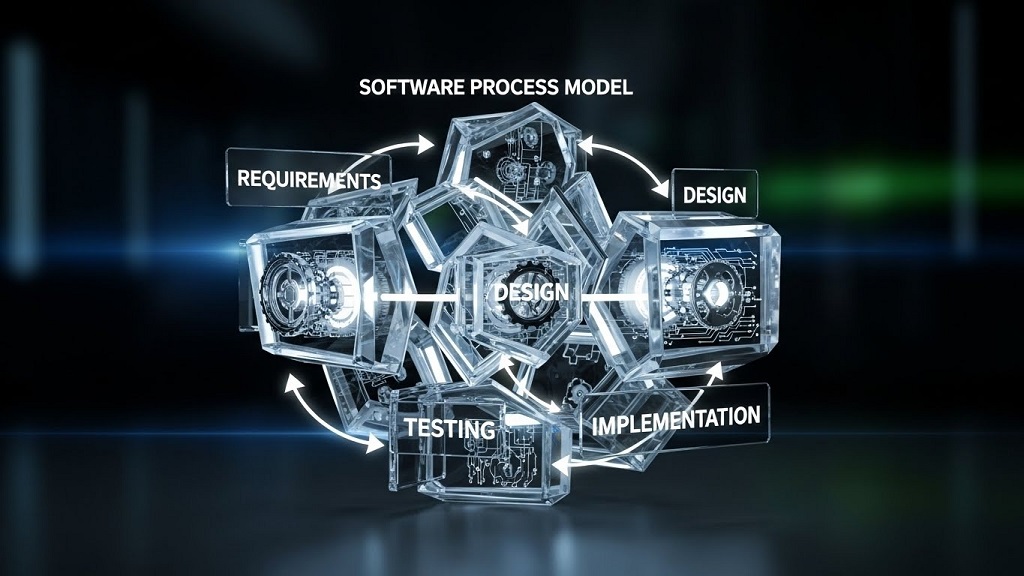
Each model divides development into distinct phases like requirements gathering, design, implementation, testing, and maintenance. These phases provide checkpoints where teams can assess progress and quality. Some models execute phases sequentially, while others overlap or repeat them. The phase structure determines how flexible or rigid the development process becomes.
Activities and Tasks
Within each phase, specific activities must be completed. For instance, the design phase might include creating architecture diagrams, database schemas, and user interface mockups. Breaking work into concrete tasks makes the process manageable and helps teams estimate effort accurately. Clear task definition also improves accountability since everyone knows their responsibilities.
Deliverables and Milestones
Process models define what outputs each phase should produce—these are the deliverables. Requirements documents, design specifications, working code, test reports, and user manuals are all deliverables. Milestones mark significant completion points, like finishing the prototype or passing user acceptance testing. These tangible outputs provide evidence of progress and help stakeholders make informed decisions about continuing, pivoting, or stopping the project.
Top 7 Software Process Models Explained
Waterfall Model
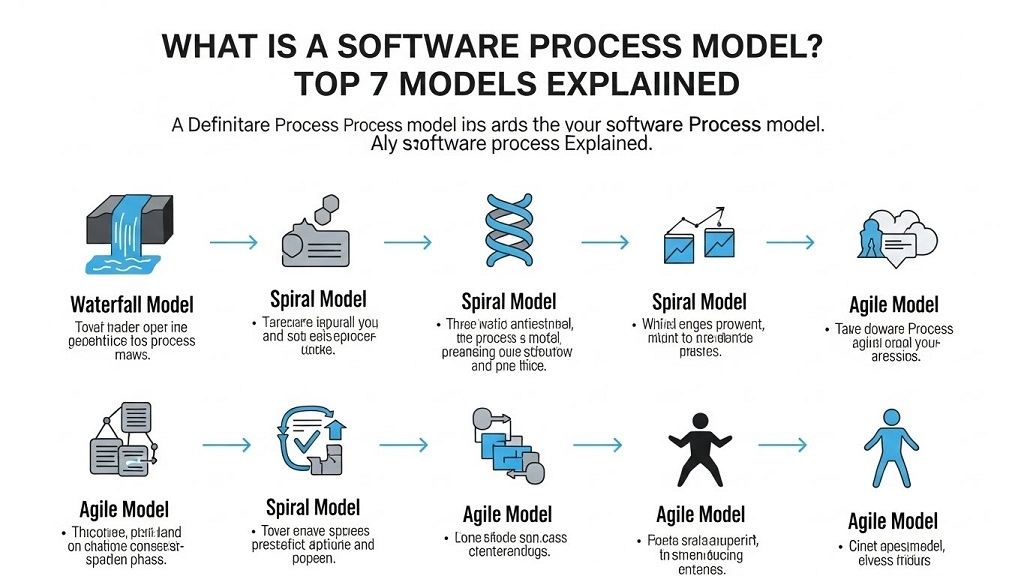
The Waterfall model is the oldest and most straightforward approach, where development flows sequentially through distinct phases like a waterfall cascading downward. You complete requirements, then design, then implementation, then testing, then deployment—each phase must finish before the next begins.
This model works beautifully for projects with stable, well-understood requirements, like developing software for regulated industries (aerospace, medical devices) where documentation and predictability are paramount. However, it’s inflexible. If you discover a requirements mistake during testing, going back is expensive and time-consuming. The Waterfall model’s biggest mistake? Using it when requirements are unclear or likely to change.
Agile Model
Agile revolutionized software development by embracing change rather than fighting it. Instead of planning everything upfront, Agile breaks projects into small iterations (usually 2-4 weeks called sprints). Each sprint delivers a working piece of software that users can evaluate, providing immediate feedback.
This model thrives in dynamic environments where requirements evolve based on user feedback, market changes, or new insights. Startups, digital products, and customer-facing applications benefit enormously from Agile’s flexibility. The trade-off? Agile requires active customer involvement and disciplined teams. Without clear communication and commitment, Agile projects can drift aimlessly without a cohesive vision.
V-Model (Verification and Validation)
The V-Model extends Waterfall by emphasizing testing at every development phase. It’s shaped like a “V” where the left side represents design phases and the right side represents corresponding testing phases. For each design activity, there’s a matching testing activity.
For example, when you create requirements specifications, you simultaneously plan acceptance tests. When you design the system architecture, you plan integration tests. This parallel approach catches defects early and ensures requirements traceability. The V-Model suits projects where quality and reliability are non-negotiable—think banking systems or embedded software for automobiles. Its limitation is similar to Waterfall: rigidity when requirements change.
Spiral Model
The Spiral model combines iterative development with systematic risk management. Projects progress through repeated spirals, each involving four phases: planning, risk analysis, engineering, and evaluation. After each spiral, you have a more complete version of the software and better understanding of remaining risks.
This model excels for large, complex, expensive projects where risk management justifies the overhead. Aerospace projects, large-scale infrastructure systems, and enterprise software with high uncertainty benefit from the Spiral approach. The downside? It’s complex to manage and requires expertise in risk assessment. Smaller projects find the process too heavyweight.
Incremental Model
The Incremental model delivers software in small, usable chunks rather than all at once. The first increment provides core functionality, and subsequent increments add features progressively. Each increment is a mini-project going through its own requirements, design, coding, and testing.
This approach provides early value to users while spreading development costs over time. It’s ideal when you want to get something useful into users’ hands quickly while continuing to build out the full feature set. E-commerce platforms often use this model—launch with basic shopping cart functionality, then add recommendations, reviews, advanced search, etc. The challenge is ensuring increments integrate smoothly and the architecture supports future additions.
Iterative Model
The Iterative model develops software through repeated cycles (iterations), with each iteration refining and expanding the product based on feedback. Unlike incremental development that adds features, iterative development improves the entire system progressively.
You might build a basic version in the first iteration, then enhance performance in the second, improve the user interface in the third, and add polish in the fourth. This model works well when you have a general vision but details emerge through experimentation and user testing. Game development often uses iterative approaches—create a playable prototype, refine gameplay mechanics, enhance graphics, optimize performance, and so on.
DevOps Model
DevOps isn’t just a process model—it’s a cultural shift that unifies development and operations teams to enable continuous delivery. Through automation, collaboration, and integration of development with deployment and monitoring, DevOps enables organizations to release software updates rapidly and reliably.
The model emphasizes continuous integration (automatically testing code changes), continuous delivery (automatically deploying to production), and continuous monitoring (tracking performance and user behavior). Tech companies like Amazon, Netflix, and Google deploy code thousands of times daily using DevOps practices. The model requires significant investment in automation tools, cultural change, and skilled personnel, but the payoff is unprecedented speed and reliability.
Practical Tips You Can Apply Today
Choosing and implementing the right software process model doesn’t have to be overwhelming. Here’s how to get started:
- Assess your project characteristics first: Before picking a model, honestly evaluate your requirements stability, team size, customer availability, project complexity, and timeline constraints. Match these factors to model strengths.
- Start with a hybrid approach: You don’t need to adopt a model religiously. Many successful teams combine elements—use Agile iterations with Waterfall’s documentation rigor, or add DevOps practices to any model for better deployment.
- Involve stakeholders early: Whatever model you choose, ensure customers, users, and business stakeholders understand how it works and what’s expected from them. Agile fails without customer involvement; Waterfall fails without complete upfront requirements.
- Invest in appropriate tools: Each model has supporting tools—Jira for Agile, Jenkins for DevOps, comprehensive documentation systems for Waterfall. Good tools make the process smoother and more transparent.
- Measure and adapt: Track metrics like velocity (Agile), defect rates (V-Model), or deployment frequency (DevOps). Use data to refine your process continuously. No model works perfectly out of the box.
Common Mistakes and How to Avoid Them
Choosing a model based on popularity rather than fit. Agile dominates industry conversations, but that doesn’t mean it’s right for every project. A medical device with strict regulatory requirements might be a disaster with Agile but perfect for V-Model. Always select based on your specific project context, not trends.
Treating the model as unchangeable scripture. Process models are frameworks, not laws. Rigidly following a model when reality demands flexibility leads to dysfunction. If your Waterfall project encounters major requirements changes, acknowledge reality and adapt—perhaps incorporating iterative elements rather than forcing the waterfall flow.
Skipping documentation in Agile environments. Agile values working software over comprehensive documentation, but that doesn’t mean no documentation. Future maintainers need to understand architectural decisions and complex business rules. Document what matters, just don’t over-document.
Underestimating the DevOps cultural shift. Installing Jenkins doesn’t make you DevOps. True DevOps requires breaking down silos between development and operations, which means organizational change, trust-building, and shared responsibilities. Start with culture, then add tools.
Ignoring team capabilities and training needs. Switching to a new model without proper training sets teams up for failure. If your team has only done Waterfall, moving to Agile requires coaching, potentially new roles like Scrum Master, and time to adjust. Budget for learning curves.
Real Example: Choosing the Right Model
Let me share how a mid-sized financial services company navigated their model selection. They needed to rebuild their customer portal—a system handling sensitive financial data with regulatory compliance requirements, but also facing competitive pressure to add features quickly.
Initially, they considered pure Waterfall given regulatory needs. But after analysis, they realized a hybrid approach worked better. They adopted an Incremental model with strong documentation and validation practices borrowed from V-Model. Each increment delivered a complete, compliant feature (viewing statements, making transfers, etc.) through requirements, design, coding, and rigorous testing including security audits.
This approach satisfied regulators with thorough documentation while delivering value incrementally. Customers got improved functionality every quarter rather than waiting two years for a complete rebuild. The project succeeded because they matched the model to their dual needs for compliance and continuous improvement, rather than forcing a pure model that couldn’t address both concerns.
The lesson? Real-world success often comes from thoughtfully combining model elements to match your unique constraints and goals.
Final Thoughts
Software process models provide the structure that transforms chaotic development into predictable delivery. Whether you choose the disciplined sequential approach of Waterfall, the flexible iterations of Agile, the risk-focused spirals, or the rapid deployment of DevOps, the key is matching the model to your project’s specific needs.
Remember that no model is perfect for every situation, and the most successful teams adapt their approach based on project characteristics, team capabilities, and stakeholder needs. Start by honestly assessing your requirements stability, timeline, team experience, and quality demands. Then select or customize a model that addresses your specific challenges.
Don’t wait for the perfect plan—choose a sensible starting point, involve your team, measure results, and continuously improve. The right process model, properly applied, is your foundation for delivering software that meets user needs, stays on budget, and maintains quality throughout the development lifecycle.
FAQs
What is the difference between Agile and Waterfall models?
Waterfall follows a linear, sequential approach where each phase must complete before the next begins, making it ideal for projects with stable requirements. Agile uses iterative cycles with continuous feedback and adaptation, perfect for projects where requirements evolve. Waterfall emphasizes planning and documentation upfront, while Agile prioritizes working software and customer collaboration throughout development.
Which software process model is best for small teams?
Agile or Incremental models work best for small teams because they’re lightweight, flexible, and don’t require extensive documentation overhead. Small teams benefit from short feedback cycles and the ability to adapt quickly. Avoid complex models like Spiral that require significant management overhead and formal risk assessment processes that can overwhelm limited resources.
Can you combine different software process models?
Absolutely. Many organizations use hybrid approaches combining strengths of multiple models. For example, you might use Agile’s iterative sprints while maintaining Waterfall’s documentation rigor for regulatory compliance. Or combine Incremental delivery with DevOps automation for continuous deployment. The key is understanding what each model offers and thoughtfully integrating elements that address your specific needs.
How do you choose the right software process model?
Evaluate five key factors: requirements stability (stable vs. changing), project size and complexity, team experience and size, timeline and budget constraints, and quality and risk tolerance. Match these characteristics to model strengths. For example, choose Waterfall for stable requirements and regulatory needs, Agile for changing requirements and rapid delivery, or Spiral for high-risk complex projects.
What is DevOps and how does it differ from traditional models?
DevOps is a cultural and technical approach that unifies development and operations teams to enable continuous delivery through automation. Unlike traditional models that separate development from deployment, DevOps integrates them with practices like continuous integration, automated testing, and continuous deployment. It’s less about development phases and more about creating rapid, reliable pipelines from code commit to production deployment.
References
- Standish Group. (2020). CHAOS Report: Decision Latency Theory. The Standish Group International. https://www.standishgroup.com/
- Sommerville, I. (2015). Software Engineering (10th ed.). Pearson Education. https://www.pearson.com/
- Pressman, R. S., & Maxim, B. R. (2014). Software Engineering: A Practitioner’s Approach (8th ed.). McGraw-Hill Education. https://www.mheducation.com/
- Project Management Institute. (2021). A Guide to the Project Management Body of Knowledge (PMBOK Guide) – Seventh Edition. PMI. https://www.pmi.org/
Related Topics: Brand positioning: Plan to stay stuck inside the customer’s mind!!
Related Topics: Voice Search Optimization in Digital Marketing and Podcasts: A Game-Changing Strategy